Securing Kids and Teens in the Car

A car seat or seat belt can only protect your child if it’s used correctly on every ride. No matter your child’s age or the type of restraint they’re using, a snug fit and proper positioning are essential to keeping them safe in a crash. These simple tips can help keep them safe on every trip.
In this article:
How to secure your child in their car seat
Tighten the harness using the pinch test
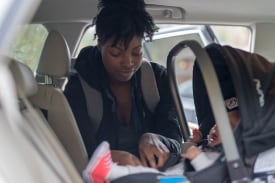
Harness straps should fit snugly against your child’s body. The pinch test can help you ensure that they’re tight enough.
Once your child is buckled into their seat, pinch the flat webbing at the shoulders. If you can pinch extra harness material between your fingers, the straps are too loose. Tighten them until you can no longer pinch any material at all.
Set the car seat chest clip at armpit level
When positioned correctly, the car seat chest clip prevents the harness straps from sliding off your child’s shoulders. This—plus a snug harness fit—secures your child in the seat during a crash. The proper chest clip position is level with your child’s armpits—not on their stomach, collarbone or neck.
Ensure straps are flat
Twisted straps don’t distribute crash forces as effectively. Instead, harness straps should lie flat against your child’s body without any twists.
Skip bulky coats
Puffy coats, thick blankets and heavy layers can prevent the harness from fitting correctly. Dress your child in thin layers to ensure a snug fit. For extra warmth, place their coat or a blanket over their harness after they’re securely buckled in.
Securing kids in their booster seats
Ensure proper seat belt positioning in the booster
A booster seat helps position the seat belt correctly when your child is too small to use the belt alone. Without a booster, the seat belt may not protect your child as intended and could increase their risk of injury in a crash. Here’s what proper positioning looks like:
- The lap belt should rest low across the upper thighs, not the stomach.
- The shoulder belts should be positioned in the middle of the shoulder, coming from slightly above, and cross at the center of the chest.
- The seat belt should not be touching the face or neck.
Encourage good riding habits
Booster seats only work if children stay sitting properly throughout the ride. Teach children not to lean forward or slouch, tuck the seat belt behind their back or place it under their arm.
- Children are more likely to sit properly in a booster seat when it fits them correctly.
- Check the label on your booster seat for minimum age. Most will require a child to be at least 4 or 5 years of age to use a booster seat.
Learn how to avoid common booster seat mistakes.
Buckle up: Proper seat belt use
Wear the seat belt correctly
Whether your teen is in the driver’s seat or your child is riding as a passenger, wearing a seat belt correctly is the best way to prevent serious injury or death in a collision. Long before they pass their driver’s test, teach kids and teens to follow these seat belt safety tips:
- The shoulder belt belongs across the center of the chest and shoulder.
- The lap belt should sit low across the hips, not across the stomach.
- The seat belt should never be placed behind the back or under the arm.
- Every passenger should buckle up on every ride—even the short ones.
Some kids move the shoulder belt behind them because it’s uncomfortable. This greatly reduces protection and increases the risk of injury. If the seat belt is cutting into their neck or causing discomfort, it’s possible your child graduated from their booster seat too soon.
Learn to avoid these other common seat belt mistakes.
Keep kids in the back seat until 13
Even after kids no longer need a booster seat, the back seat is the safest place to ride whenever possible. Air bags are designed for adult bodies—not kids’ or teens’ bodies, which are still growing. Air bags can cause serious harm to their developing bones. Georgia car seat laws require kids to ride in the back seat until at least age 8, but safety experts recommend age 13.
FAQ
When did seat belts become mandatory?
The federal government required car manufacturers to install car seats in all vehicles starting in 1968, but wearing them wasn’t mandatory in Georgia until 1988.
The Centers for Disease Control and Prevention (CDC) estimates that seat belts prevent nearly half of all crash-related fatalities, and the National Highway Traffic Safety Administration (NHTSA) reports that seat belts save at least 15,000 lives per year.
Can a 4-year-old sit in a booster seat?
When it comes to car seat requirements, age is only one factor—and it’s the least important one. A forward-facing car seat provides much more protection than a booster seat, so your child should remain in their car seat for as long as possible. Your child should transition only once they have reached the height or weight limit of their forward-facing car seat. For more information about this transition, check out our complete guide to changing car seats.
What is the Ride Safer Travel Vest and is it safe to use?
The Ride Safer Travel Vest is a federally approved child restraint that may be appropriate for some children and travel situations. Families may find it easier to travel with vests than to juggle multiple car seats. They may also help families with multiple kids who struggle to fit 3 or more car seats into their cars. However, these and similar vests may not be the best choice for every child or situation.
- Travel vests don’t provide side impact protection during a crash.
- It may be difficult to ensure a proper fit.
- Correct harness use is essential in keeping your kids safe.
If you choose to use a travel vest, follow the manufacturer’s height and weight requirements and consult a certified child passenger safety technician (CPST) to ensure a proper fit before you travel.
If your child has an injury or is showing signs of illness, call your doctor or visit an urgent care center. If your child has a life-threatening injury or illness, is having trouble breathing or is unconscious, call 911 and/or visit an emergency department immediately.