Nonfatal Drowning: Dara’s Miracle Story
Key takeaways:
- Dara’s love for water turned into a nightmare when two teens noticed her at the bottom of a neighborhood pool during a party.
- Dara miraculously recovered from the non-fatal drowning, and her family wants everyone to know about the importance of water safety.
- Drowning is silent and can happen quickly.
-
Active supervision is the best way to keep kids safe around water, but it's only one of many layers of protection.
- Keep beginner swimmers within arm’s reach, and experienced swimmers in sight at all times.
- Designate at least one adult to be a water watcher.
- Keep a close eye on kids during transition points, when they aren’t supposed to be in the water.
- Use U.S. Coast Guard–approved life jackets as a layer of protection, along with supervision.
- Do not rely on other kids or teens to supervise other children in the water.
In this article:

Dara's story
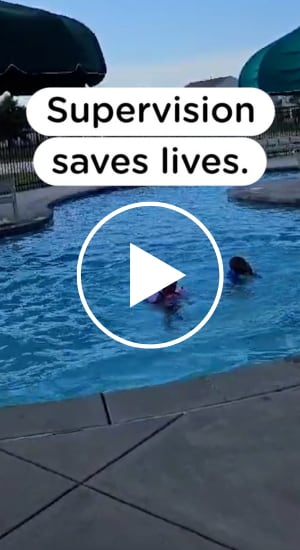
In August 2023, Dara traveled with her mom (Bisi), dad (Wale) and older brother (Dayo) from Charlotte, NC, to Fayetteville, GA, to celebrate a family friend’s birthday at a neighborhood pool.
When the kids and teens started to swim, the grown-ups asked the teens to keep an eye out for the younger kids in and around the pool area. Everything was going great.
Around 4 p.m., everyone left the pool area to take part in pizza, cake and games. While Bisi was assisting with the clean-up process, Wale checked in on their children playing table bowling before stepping away to check emails at their family friend’s home a few yards away. He left thinking the other adults in the area had things covered and everyone was staying out of the pool for a little while longer.
Wale went inside of their family friend’s home to grab his phone. “I went inside and checked some emails. I was in there for about 5 or 6 minutes,” said Wale. “Then I came back out to the clubhouse and didn’t see my daughter.” At first Wale thought Dara had gone to the bathroom or went to the table area where everyone gathered.
Moments later, two of the teens noticed Dara at the bottom of the pool. They immediately jumped in to rescue her.
“I believe she thought she had her floater on because she likes to run and dive into the water. So, she went to the deepest area, ran, and dove in,” said Bisi.
According to surveillance video from the neighborhood pool, Dara was in the water for a total of 10 minutes. Having taken swim lessons in the past, Dara was able to doggy paddle for about 4 minutes until exhaustion set in.
Dara was underwater for 6 minutes.
After the teens pulled Dara out of the water, one of the other partygoers called 911. As they waited for emergency services, Dara’s mom (a physician), dad and another party attendee took turns administering CPR.
When EMTs arrived, Dara did not have a pulse. The emergency responders worked on Dara for a few minutes before they were able to regain a pulse. Bisi and Wale were relieved to hear the words, but they knew they still needed a miracle.
Dara was taken to the closest hospital, which happened to be an adult facility. Her medical team decided to life-flight her to Scottish Rite Hospital. Filled with emotions ranging from fear and terror to panic, her parents were unsure she’d survive the drowning incident.
“She was still limp and blue,” recalled Bisi. “At that point, I assumed she was gone … I did. I just went into prayer. I was just numb.”
“The first 24 hours were just hard. Because they did not know if she was going to make it through.”
No one knew if Dara’s heart, lungs and brain could recover from the injuries she suffered.Given how long she was underwater, Dara’s care team thought she’d experienced irreversible brain damage due to the severity of her injuries.
“It was one of those things where I think it was just a faith walk … I mean, that is the only way I could explain being able to survive those days,” said Bisi.
Dara's recovery at Children's
Dara spent three weeks in the ICU at Scottish Rite. Each day felt like forever for this family and community who were rooting for their little one to pull through successfully.
After her medical team saw improvements in her brain, lungs and heart function, Dara was transferred from the ICU to our inpatient rehab unit, where the care team expected Dara to stay for a month. Dara left rehab after one week.
“She just started flourishing. One day she couldn’t even get out of bed. The next day she was sitting up and able to walk to therapy,” said Bisi.
Wale and Bisi want to share their story with other caregivers so they don’t make the same mistakes. They want everyone to know the importance of always keeping a close watch on children in and around water.

“Never take your eyes off them—not even for one second—if you have young ones around water. Not even a second,” said Bisi.
Less than 6 months later, Dara’s recovery is considered to be the miracle her parents prayed for. While Dara does remember being at the party, she doesn’t remember the drowning. She is back to being her normal energetic and witty self. Dara’s parents, however, will never forget those terrifying moments.
“I still get goosebumps when I look at her. She’ll just be going about life like a normal 5-year-old, and I’ll get goosebumps thinking about how fortunate we are things turned out the way they did,” said Bisi.
Thankfully, Dara does not have any lingering effects from the drowning injuries. Her parents know how lucky they are and that not everyone shares the same fortune, with more than 350 children in the U.S. dying each year from drowning.
The Adesokans believe this incident has made them a stronger family. In addition to wanting more caregivers to know the importance of water safety, they want to encourage families to cherish every moment of life and to not worry about the little things.

Drowning is preventable
Here are a few tips from our emergency medicine physicians to help prevent fatal and non-fatal drowning:
- Keep beginner swimmers within arm’s reach. If a child cannot confidently swim two laps of a pool unassisted, an adult should be supervising closely enough to reach out and touch them at all times. This way, the adult can immediately help the child.
- Keep strong swimmers within eye’s reach. Remind older kids and teens to never swim alone, no matter how skilled they are with swimming, and to never swim under the influence of alcohol or drugs.
- Never substitute flotation devices for supervision. You are always your child’s best lifeguard. No device will ever provide the level of drowning prevention protection you can. These devices can also give kids a false sense of confidence in the water. When you do use a life jacket, choose one that is tested approved by the U.S. Coast Guard, as not all flotation devices are as effective as others.
- Eliminate distractions around water. While you’re supervising a child in or around water, make sure you’re alert and aware. That means you’re not talking to friends or family, tending to another child, texting or talking on the phone, or drinking alcohol or under the influence of drugs.
Learn about more layers of protection around water.
Near-drowning vs. nonfatal drowning
It’s common to hear about near-drownings in the news, but our doctors and nurses refer to drownings as “fatal” or “non-fatal” after a group of experts suggested a new consensus definition in 2002 for drowning to decrease the confusion over the more than 20 previously used terms. These misleading terms included “dry drowning,” “near drowning,” “delayed drowning,” “secondary drowning” and “silent drowning.” Because drowning—whether fatal or non-fatal—is such a significant and life-altering event, it is important to use accurate language.